Chalk Bucket Size Calculator
Tick what you actually carry and find out how many litres your session needs — before you buy a bag that turns out to be a chalk container with a lid.
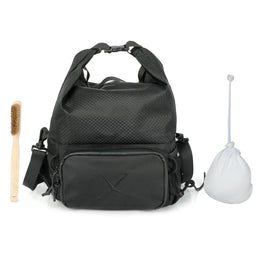
These are estimates, not measurements — sized against a US men's 9 shoe and standard gear, and rounded honestly. The "bag you need" figure adds about 18 %, because soft gear never packs to 100 % of a bag's rated litres. Treat the result as a size bracket, not a spec.
How big should a chalk bucket be?
Almost every "what size" argument is really a disagreement about what the bag is for. Four brackets cover the whole market — drawn here to scale, with yours lit up once you've ticked your kit above.
Chalk, one hand at a time. A rope-climbing tool.
Chalk, brush, phone. Your shoes travel elsewhere.
Chalk, shoes, brushes, a layer. One bag for the session.
All of it, plus pad straps. Overkill indoors.
| Size | What it is | Carries | Honest verdict |
|---|---|---|---|
| 0.5 – 1 L | Waist chalk bag | Chalk, one hand at a time | Built for rope climbing. Not a bouldering bag. |
| 2 – 4 L | Small chalk bucket | Chalk, brush, phone | Fine for a gym you drive to with a separate bag. |
| 5 – 8 L | Bucket sized as a gear bag | Chalk, shoes, brushes, layer, bottle | The one-bag answer for a gym session or a short approach. |
| 15 L + | Crag pack | All of the above plus pad straps | Necessary for a full day out. Overkill for the gym. |
The gap most people fall into is between rows two and three. A 3 L bucket holds chalk and a brush, so you end up carrying a second tote for your shoes — and the tote is the thing you leave in the car and then need. Our own Ascend sits in the 5 → 8 L bracket for exactly that reason: 5 L rolled shut, 8 L with the roll-top opened out.
What actually eats the space
Run the calculator honestly and the same three things dominate every time: shoes, a layer, and a full water bottle. Together they're usually more than half the total. Chalk — the thing the bag is named after — is under a litre.
That's the whole argument for a bucket sized as a gear bag rather than a chalk container with a lid. If your bag can't take shoes and a hoodie, it isn't carrying your session, it's carrying your chalk while something else carries your session.
Three sizing mistakes
Buying for the minimum session
People size the bag for a summer evening at their local gym, then spend winter with a hoodie under one arm. Size for your bulkiest realistic session, not your lightest.
Ignoring the opening
Litres tell you nothing about whether two hands fit inside at once. A tall narrow 6 L bucket is worse to chalk from than a wide 4 L one. Volume is a filter, not the decision.
Forgetting that chalk goes everywhere
Any bag where shoes and loose chalk share one compartment will coat the shoes. That's a closure and compartment question, not a capacity one — we went through it in how to stop chalk getting everywhere.
Quick answers
What size chalk bucket do I need for bouldering?
For a gym session with shoes, chalk, brushes and a layer, most climbers land between 5 and 8 litres. Below 4 L you'll be carrying a second bag; above 15 L you've bought a backpack.
How many litres is a normal chalk bag?
A waist chalk bag is roughly 0.5 to 1 litre — enough for chalk and nothing else. Chalk buckets start around 2 L and the gear-bag sized ones run 5 to 8 L.
Will climbing shoes fit in a chalk bucket?
Only in the larger brackets. A pair of bouldering shoes takes roughly 2 litres, so a 3 L bucket is close to full with shoes alone. You want 5 L or more if the shoes travel inside with everything else.
Is a bigger chalk bucket always better?
No. An oversized bucket lets gear tip around, sits badly on the approach, and tempts you into carrying things you never use. The right size is the one that's nearly full at the end of the calculation above.
Not sure what belongs in there in the first place? The bouldering gym bag checklist covers what earns its place and what doesn't. More free tools on the tools page.